

Crabapple trees are everywhere in autumn, often in yards and parks where the fruit just falls and gets ignored. That is a shame, because this crabapple jelly recipe turns those small, sour apples into a beautifully clear, rosy-pink jelly with a sweet-tart flavor that tastes like the best apple jelly you have ever had.
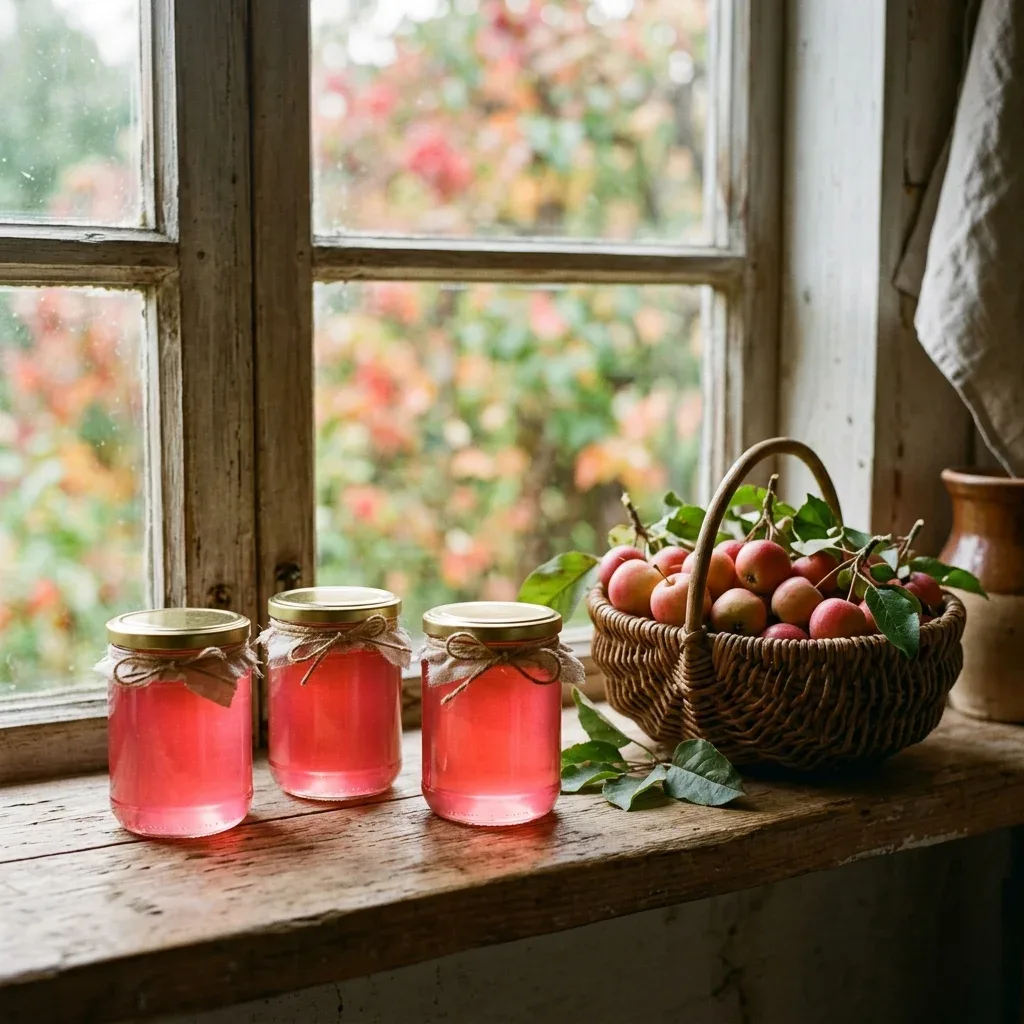
Quick answer: simmer 3 lb whole crabapples in water until soft, let the juice drip through a jelly bag overnight, then boil 4 cups juice with 3 cups sugar and 2 tablespoons lemon juice to 220°F (104°C). Crabapples have so much natural pectin that you don’t need to add any.
RECIPE
Crabapple Jelly (No Added Pectin)
Ingredients
- 3 lb crabapples about 1.4 kg, a mix of ripe and a few slightly under-ripe
- 6 cups water about 1.4 liters, or enough to just cover the fruit
- 3/4 cup granulated sugar per 1 cup of strained juice (about 3 cups total)
- 2 tablespoons lemon juice bottled or fresh
Method
- Rinse the crabapples, and remove stems, leaves and any bad spots. Leave them whole if small, or halve larger ones. There is no need to peel or core them; the skins and cores hold much of the pectin.
- Put the crabapples in a large pot and add water until they are just covered. Bring to a boil, then simmer, partly covered, for 20 to 25 minutes, until soft. Gently mash them halfway through.
- Pour the fruit and liquid into a damp jelly bag or a colander lined with 3 or 4 layers of damp cheesecloth, set over a bowl. Let it drip for at least 4 hours or overnight. Do not squeeze the bag, or the jelly will be cloudy.
- Measure the juice. You should have about 4 cups. For every 1 cup of juice, measure 3/4 cup sugar.
- Put a few small plates in the freezer. Prepare a boiling water canner and wash jars and lids. Sterilize the jars by boiling them for 10 minutes.
- Pour the juice and lemon juice into a wide pot and bring to a boil. Stir in the sugar until dissolved, then boil hard, skimming off foam, until the jelly reaches 220°F (104°C), or 8°F above the boiling point of water at your altitude. This usually takes 10 to 20 minutes.
- Check the set: a little jelly on a frozen plate should wrinkle when pushed after 1 minute, or the jelly should drop off a metal spoon in a single sheet.
- Ladle the hot jelly into the hot sterilized jars, leaving 1/4 inch headspace. Wipe the rims, add lids and bands, and process in a boiling water bath for 5 minutes (at up to 1,000 ft altitude). Let the jars cool undisturbed for 12 to 24 hours and check the seals.
Notes
Private Notes
Tried this recipe?
Let us know how it was!Why Crabapple Jelly Doesn’t Need Pectin
Pectin is what makes jelly set, and crabapples are one of the richest natural sources of it, along with tart apples, quinces and currants. Most of it is in the skin and core, which is why you cook the fruit whole. Slightly under-ripe crabapples have even more pectin, so a mix of ripe and not-quite-ripe fruit gives the most reliable set.
Which Crabapples Can You Use?
Nearly all crabapples are edible when cooked, though they vary a lot in flavor. Larger ones, like Dolgo, Chestnut and Whitney, are especially good for jelly. Tiny ornamental varieties can be very tart or a little bitter, so taste one first. Red-skinned crabapples give the prettiest pink color. If you are foraging, be sure the tree really is a crabapple and hasn’t been sprayed with chemicals.
Like regular apple seeds, crabapple seeds contain a compound that can release cyanide when crushed and eaten in large amounts. Straining the juice through a jelly bag removes them, so the finished jelly is safe.
How to Get Clear Jelly
- Let the juice drip on its own. Squeezing the bag pushes pulp through and clouds the jelly.
- Use a damp jelly bag or several layers of damp cheesecloth.
- Skim foam carefully during the boil.
- Let the jars sit undisturbed while they set.
Cloudy jelly still tastes great; it just isn’t as jewel-like.
Troubleshooting Crabapple Jelly
- Jelly didn’t set: give it 48 hours first, since some jellies take time. If it is still runny, pour it back in the pot and reboil to 220°F, then re-jar in clean, hot jars and reprocess.
- Too stiff or rubbery: it was cooked too long. Use it as a glaze for meats.
- Crystals in the jelly: sugar was not fully dissolved, or the jelly was boiled too slowly for too long.
- Bubbles: the jelly was poured too slowly or not skimmed. Harmless.
Storing Your Jelly Safely
For shelf-stable jars, process them in a boiling water bath. The times in this recipe follow guidance from the National Center for Home Food Preservation, which also explains how to adjust for altitude. If a jar doesn’t seal, refrigerate it and use it within a month.
Ways to Use Crabapple Jelly
- On toast, biscuits and scones
- With a cheese board, especially aged cheddar or brie
- Melted as a glaze for pork, ham or roast chicken
- Spooned into thumbprint cookies
- Brushed over a fruit tart for a glossy finish
Want more ways to use your fruit? Crabapples also make great sauce, butter and pickles. See our crabapple recipes for 10 ideas. For another fall bake, try this apple cider glazed doughnut.
Crabapple Jelly FAQs
How many crabapples do I need? About 3 lb (1.4 kg) gives roughly 4 cups of juice, enough for 4 half-pint jars.
Can I use less sugar? Traditional jelly without added pectin needs the full amount of sugar to set. For low-sugar jelly, use a pectin made for low or no sugar recipes and follow its directions.
Can I freeze crabapple juice? Yes. Freeze the strained juice for up to a year and make jelly whenever you like.
Why is my jelly brown instead of pink? Yellow or green crabapples give amber jelly. Overcooking can also darken it.