
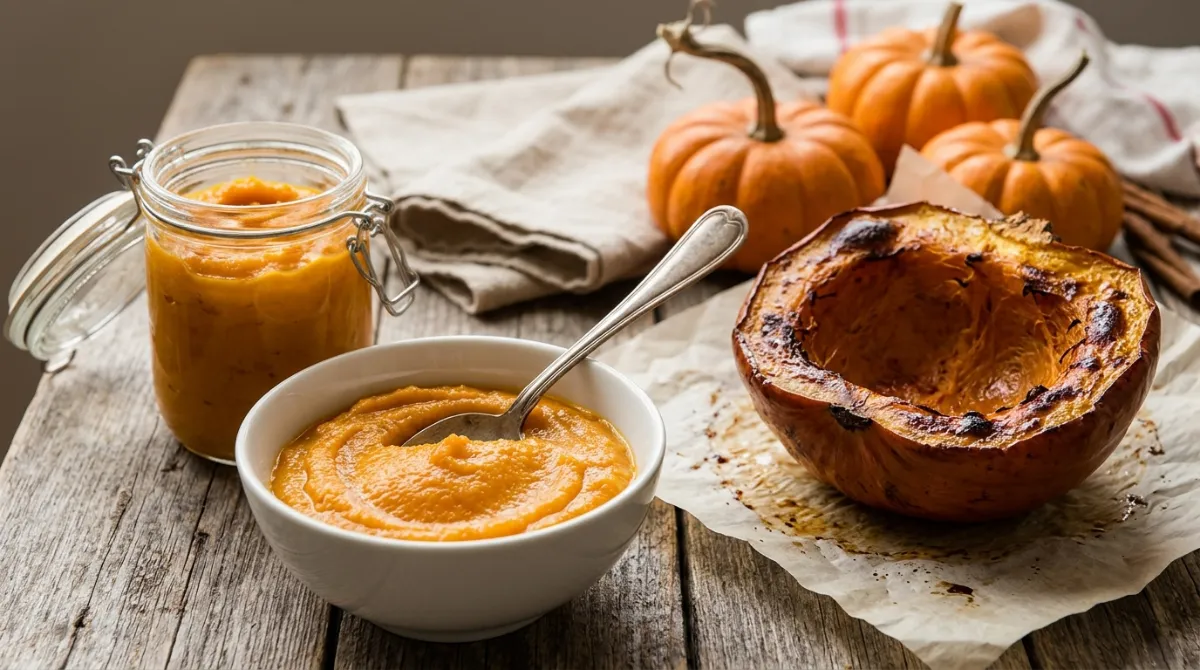
Here’s the whole secret to how to make pumpkin puree from fresh pumpkin: chop a little pie pumpkin in two, pull out the seeds and goop, then roast it face down at 400°F (200°C) till a fork slides in with zero effort. Scoop, blend, done. Takes about an hour, and most of that you’re not even in the kitchen. It tastes sweeter than canned, kind of nutty too.
I used to think homemade puree was a fussy Pinterest thing. Nope. The oven does basically all of it. And one pumpkin gets me a pie plus a batch of muffins, with a couple spoonfuls left for oatmeal the next morning.
Thanksgiving is Thursday, November 26 this year, so there’s loads of time to roast a few now and stash them in the freezer. Need something to bake with it? Every pumpkin recipe on the site lives on our pumpkin recipes page.
Quick Facts
- Makes: about 3 cups (730 g) from a 3 lb pie pumpkin
- Hands-on: 15 minutes
- Oven: 45 to 60 minutes at 400°F (200°C)
- Tools: sharp knife, sheet pan, food processor or blender
- Make ahead: yes, 3 to 4 days in the fridge or months in the freezer
On this page: Best pumpkins · Step by step · Oven vs. Instant Pot · Thick vs. watery · How much you get · Storing and freezing · FAQ
Which Pumpkins Make the Best Homemade Puree?
Grab a pie pumpkin. Some stores label them sugar pumpkins, same thing. They’re the little 2 to 5 pounders, heavy, with dense sweet flesh and hardly any strings. Those giant jack-o’-lantern ones? Bred for carving, not eating. Edible? Yep. Good? Not really. The puree is pale, watery, and has this weird cucumber thing going on.
At the store I’ll lift three or four and keep whichever one feels weirdly heavy. Stem should be dry. Zero soft spots. Then I press a fingernail into the skin. If it barely leaves a mark, it’s ripe (University of Illinois Extension uses that exact test).
Quick cheat sheet for what you’ll see at the farm stand:
| Pumpkin | Flesh | Puree result | Use it? |
|---|---|---|---|
| Sugar / pie pumpkin | Dense, sweet | Smooth, bright orange | Best all-round pick |
| Long Island Cheese | Thick, low string | Silky, mild, a bit pale | Great for pie |
| Cinderella (Rouge Vif d’Etampes) | Moist, sweet | Loose, needs draining | Yes, drain it |
| Dickinson | Deep orange, firm | Thick, like canned | Yes, if you find one |
| Carving / jack-o’-lantern | Thin, stringy | Watery, bland | Skip it |
Okay, that Dickinson one is my favorite bit of pumpkin trivia. It’s tan and kinda lumpy, looks more like a squash than a pumpkin. And it’s what most canned pumpkin is made from! It’s even the same species as butternut squash, Cucurbita moschata. So if you ever thought canned pumpkin tasted a little squashy… yep. There’s more on the species over on Wikipedia’s pumpkin page.
How to Make Pumpkin Puree From Fresh Pumpkin
Exact amounts and times are down in the recipe card. This part is the how, plus the small stuff I’ve learned the messy way.
- Oven to 400°F (200°C), sheet pan lined with parchment. Don’t skip the paper. Pumpkin sugar glues itself to a bare pan and then burns.
- Halve it. Knock the stem off first. Then cut top to bottom. Pumpkin wobbling around? I just shave a sliver off one side so it quits rolling.
- Scoop. My ice cream scoop gets more use in October than in July, it’s that good at scraping out strings. Keep the seeds, they roast up great.
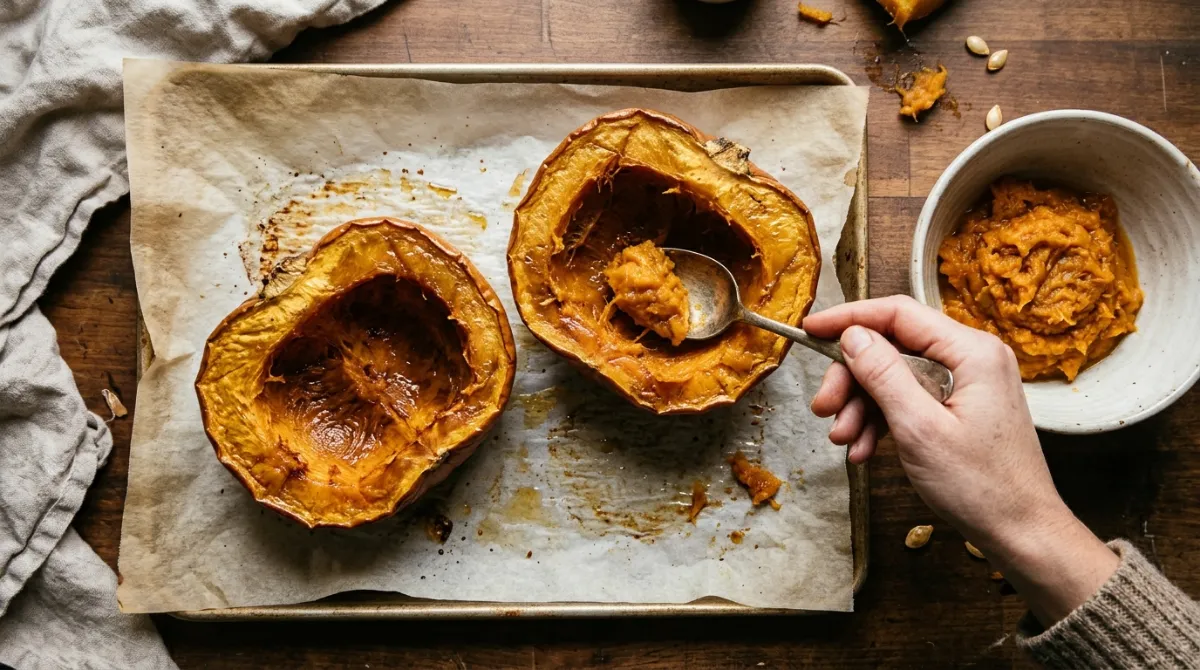
- Roast face down for 45 to 60 minutes. A little oil on the cut side is nice but not required. It’s ready when the skin looks blistered and slumped and a fork goes in like butter.
- Let it cool about 15 minutes. Trust me on this one, the steam is no joke. After that the flesh pretty much falls off the skin with a spoon.
- Blend. Food processor, 2 minutes or so, scrape once. Too thick to move? Add water, but like, a tablespoon at a time. I rarely need it.
First time cutting a whole pumpkin? Go slow, keep the tip of the knife down. Little pumpkins are so much easier to cut, which is half the reason I buy them.
RECIPE
Homemade Pumpkin Puree From Fresh Pumpkin
Ingredients
- 1 sugar pie pumpkin about 3 lb (1.4 kg), washed
- 1 tsp neutral oil 5 ml, optional, for brushing
- 1 to 3 tbsp water 15 to 45 ml, only if needed for blending
Equipment
- Large chef’s knife
- Rimmed sheet pan
- Parchment paper
- Food processor
- Fine-mesh strainer and coffee filters
Method
- Heat the oven to 400°F (200°C). Line a rimmed sheet pan with parchment paper so the pumpkin sugars don’t stick and burn.
- Cut off the stem, then halve the pumpkin from top to bottom with a large chef’s knife. Slice a thin piece off one side first if it rolls.
- Scrape out the seeds and stringy pulp with a metal spoon or ice cream scoop. Save the seeds for roasting if you like.
- Brush the cut sides lightly with oil if using. Place the halves cut side down on the pan.
- Roast 45 to 60 minutes, until the skin looks blistered and slumped and a fork slides into the thickest part with no pressure.
- Let the pumpkin cool on the pan for about 15 minutes, until safe to handle. Scoop the soft flesh away from the skin with a spoon.
- Blend the flesh in a food processor for about 2 minutes, scraping the bowl once, until completely smooth. Add water 1 tablespoon at a time only if it won’t move.
- For pie or bread, drain the puree in a coffee-filter-lined strainer set over a bowl in the fridge for 1 to 2 hours, until it holds a soft mound like canned pumpkin.
- Use right away, refrigerate in a covered container up to 3 to 4 days, or freeze in 1 3/4 cup (425 g) portions for up to 6 months.
Nutrition
Notes
Private Notes
Tried this recipe?
Let us know how it was!Oven, Instant Pot, Steaming or Microwave?
Roasting wins on flavor, no contest. All that dry heat pulls out water and toasts the sugar a little, and you can really taste it. The others are faster. You just lose a bit of that. Here’s how they stack up:
| Method | Time | Texture | Best for |
|---|---|---|---|
| Oven roast, halves, 400°F (200°C) | 45 to 60 min | Thick, sweet, deepest flavor | Pie and baking |
| Instant Pot, 1 cup water, trivet | 15 min high + natural release | Soft, a bit wetter | Busy weeknights |
| Steaming 2-inch chunks | 15 to 20 min | Wet, mild | Soup, baby food |
| Microwave, covered halves | 15 to 20 min, check every 5 | Uneven, watery spots | Small pumpkins only |
Went the steamer or Instant Pot route? Spread the chunks out on a sheet pan and walk away for 10 minutes before you blend. A surprising amount of water just steams off.
Why Is My Homemade Pumpkin Puree Watery?
Because fresh pumpkin is just wetter than canned. That’s the number one complaint I hear, and a pumpkin from a rainy summer can be even worse. Runny puree means a cracked pie, gummy bread, pudding that won’t set. Annoying.
Easy fix though. I set a coffee filter in a strainer (doubled cheesecloth works too), plop the puree in, rest it over a bowl and slide the whole thing into the fridge. Give it an hour, maybe two. Super loose batch? Overnight. You’ll look at that bowl of yellow liquid and go, wow. It’s done when a spoonful holds a soft little mound, kind of like canned.
No time to drain? Cook it down. Pan on medium-low, then stir, stir, stir. After 10 to 15 minutes it gets thicker and goes from glossy to matte. Fair warning, it spits.
Oh, and the liquid you drained off is faintly sweet. I’ve tossed it into smoothies and soup. Just don’t pour it back into pie filling.
What’s New With Pumpkins This Fall
2026 was a tough year for some Midwest pumpkin growers. Illinois grows way more pumpkins than any other state, around 533 million pounds in 2025 according to the USDA Economic Research Service. This season, though, a few Illinois farms lost whole acres to flooding and a late May frost, as The Center Square reported in October 2026. Canned pumpkin was still expected to be on shelves.
So what’s that mean for you? Wet-year pumpkins tend to be juicier. Drain yours, and when a recipe says one 15-ounce can, put a bowl on the scale and weigh out 425 g. No guessing.
Also, right now is the time to buy. Lots of farm stands knock prices down after Halloween. A cheap 3 or 4 lb pie pumpkin in early November is about as budget as puree gets, and it freezes really well for the holidays.
How Much Puree Does One Pumpkin Make?
Rough rule: 1 cup of puree per pound of whole pumpkin, a little under that once it’s drained. So a 3 lb pie pumpkin lands around 3 cups (730 g). That’s almost two cans’ worth. Thick-walled ones beat that. Stringy, watery ones don’t.
For reference, a regular can is 15 ounces (425 g), roughly 1 3/4 cups. I always weigh mine when I’m subbing homemade for canned. Cups lie with fresh puree, because it can be so loose, and that’s where a lot of recipes go sideways.
Common Mistakes (and Easy Fixes)
Using a Carving Pumpkin
It’ll work if you’re stuck. Pale, bland puree, though. Roast it longer and then cook it down in a pan to wake up the flavor.
Roasting Cut Side Up
The top dries out and the part near the skin stays hard. Flip them over. Face down, the pumpkin basically steams itself.
Skipping the Drain
Big one for pie. Spoon some on a plate and wait a minute. Puddle forming? Drain before baking.
Blending While Piping Hot
Hot stuff in a sealed blender can pop the lid right off. Ask me how I know. Give it 15 minutes, or use a food processor with the feed tube open.
How to Use Homemade Pumpkin Puree
Pretty much anywhere a recipe says canned pumpkin or pumpkin puree, as long as you’ve drained it to about the same thickness. Pie, obviously. My pumpkin sugar pie made from a real pie pumpkin was written with fresh puree in mind.
Undrained, looser puree? Soup is perfect for it since a bit of extra water doesn’t matter there. I also stir it into oatmeal, pancake batter, chili. And a spoonful in mac and cheese sauce adds color and a little sweetness most kids never even notice.
One mix-up to watch for: puree vs. pumpkin pie filling. Puree is just pumpkin. Pie filling (or “pie mix”) already has sugar and spices in it. Not the same, can’t swap them.
How to Store and Freeze Pumpkin Puree
Covered in the fridge, you’ve got 3 to 4 days. University of Illinois Extension says so, and it matches the leftovers line on the FoodSafety.gov cold storage chart.
Anything past that, freeze it:
| Where | How long | How to |
|---|---|---|
| Fridge | 3 to 4 days | Airtight container, cooled first |
| Freezer bags | Best within 6 months | Measure 1 3/4 cups per bag, press flat, freeze on a sheet pan |
| Ice cube tray | Best within 6 months | Freeze, then pop cubes into a bag (about 2 tbsp each) |
| Home canning | Not safe | Freeze instead |
Yep, that last line catches people off guard. Penn State Extension says flat out: don’t can mashed or pureed pumpkin. Not in a pressure canner, not in a water bath. Turns out it’s too thick, and heat can’t reliably reach the middle of the jar. Cubes are the only form with a tested pressure-canning method. Their guide to preserving pumpkin puree has the full details.
Thawing is easy, just move a bag to the fridge the night before. It’ll weep a bit of liquid. Stir that back in for soup, pour it off for pie.
Fresh Pumpkin Puree FAQ
Is fresh pumpkin puree better than canned?
Depends what you’re after. Fresh is brighter and a touch sweeter, and you decide how thick it ends up. Canned wins on consistency, it’s thick and the same every single time. For pie? Both are great, just drain the fresh stuff till it’s as thick as canned.
Do I need to peel the pumpkin first?
Nope, and please don’t. Peeling a raw pumpkin is slow and a little scary with a knife. Roast it in its skin, and the soft flesh scoops right out. The only time you’d peel is if you’re steaming or boiling raw chunks.
Can I use a carving pumpkin for puree?
If it’s uncut and still firm, sure. You’ll get watery, kinda bland puree though, so drain it hard or cook it down. But a carved jack-o’-lantern that sat on the porch for a week? That one goes in the compost, not the pie.
How long does homemade pumpkin puree last in the fridge?
Three to four days, covered. If you know you won’t get to it, freeze it in measured bags right away. It’ll taste its best for around 6 months in there.
Can I can homemade pumpkin puree?
No, sadly. Penn State and other extension services say puree is too dense for the heat to get through evenly, so it isn’t safe in jars. Freeze it. If you really want shelf-stable pumpkin, cubes can be pressure canned with a tested recipe.
Should I add salt or sugar to pumpkin puree?
I wouldn’t. Pretty much every recipe out there expects plain pumpkin, no sugar, no salt. Season it now and your pie or bread could end up too sweet or salty later. Save the seasoning for the final dish.
Can I make pumpkin puree in a blender?
Yep. Cool it for 15 minutes first, then go in batches, poking it down with the tamper (or a spatula, with the blender off). Honestly a food processor handles thick puree better, no extra liquid needed.
Roast One This Weekend
Last tip, and it’s my favorite: roast two. The oven’s on anyway, and pumpkin number two goes straight into the freezer for December. Tried it? Tap a star on the recipe card and let me know in the comments which pumpkin you used. Pin this for later too. Then put that puree to work in a pie or my roasted pumpkin soup.