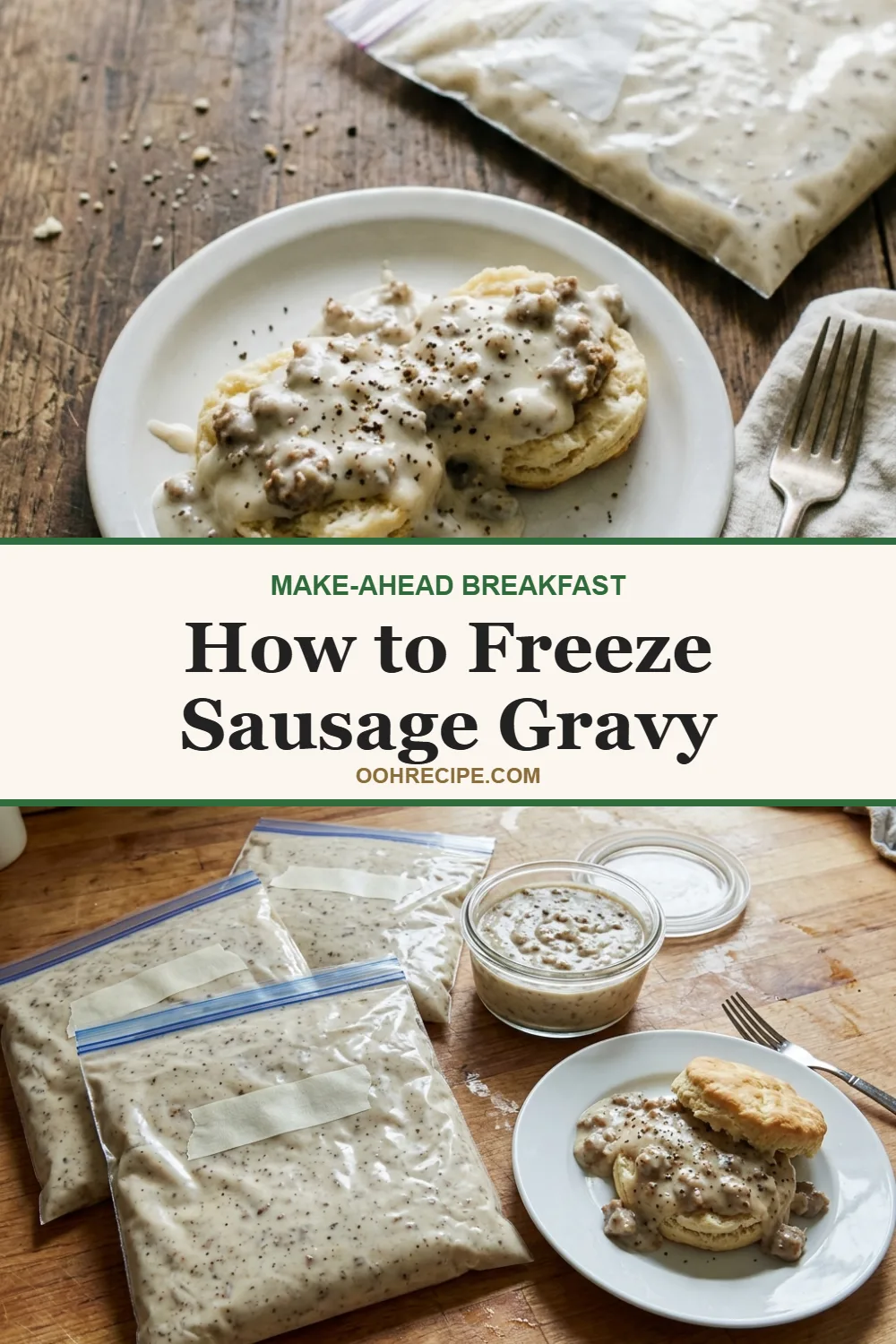
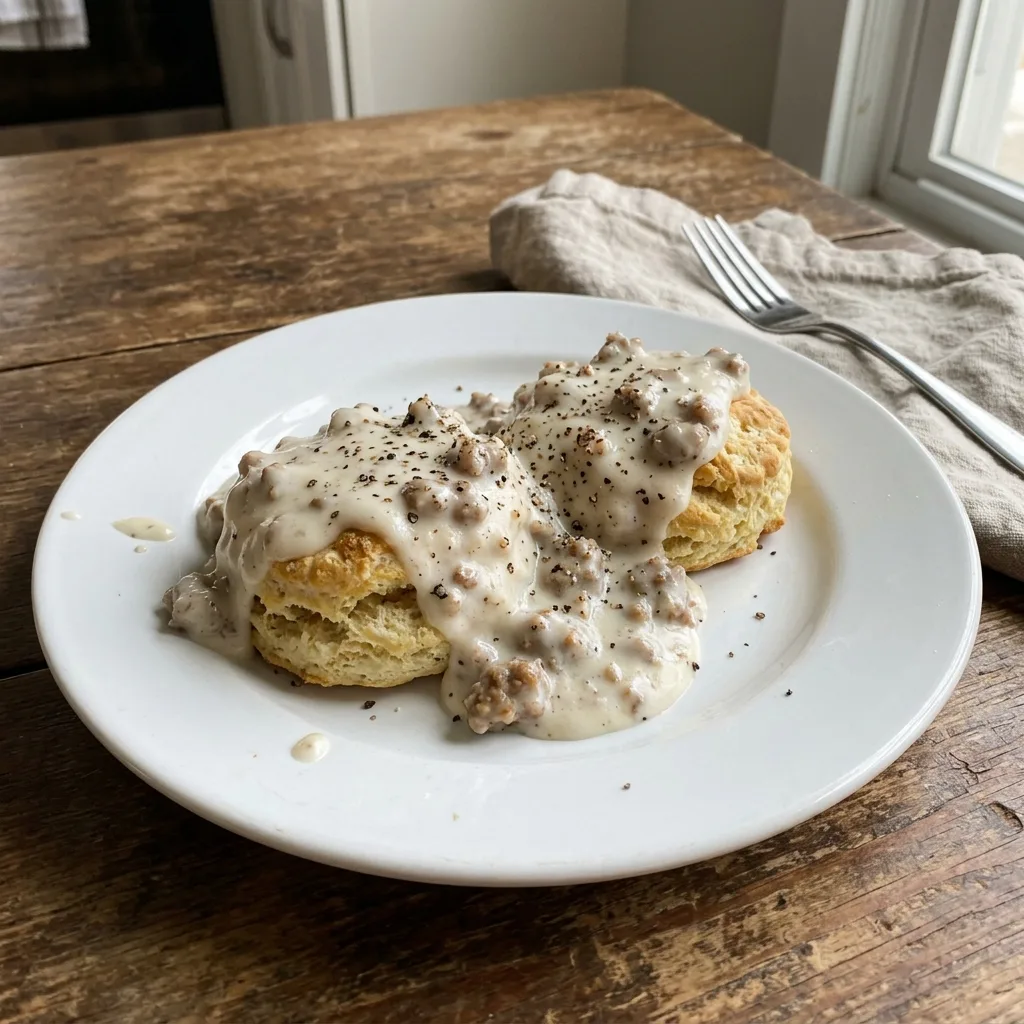
Can you freeze sausage gravy? Short answer, yep. My mom swore you couldn’t (“the milk breaks, it’s ruined”), so I didn’t even try until a couple of winters ago when I’d made way too much for a brunch that got snowed out. Turns out she was half right. It does look a little rough coming out of the freezer. But a slow reheat with a splash of milk and a whisk, and you’d never guess. Get it cold quickly, bag it in portions, and plan to eat it within 2 to 3 months.
That’s the quick version. The rest of this post is about the stuff that actually goes wrong (grainy, watery, a little greasy on top) and how I deal with it. Most Sundays I make a big skillet, eat some, and freeze the rest in little bags. Come Tuesday, biscuits and gravy takes me about ten minutes. Not bad for a weekday.
Quick Facts
- Freezer time: 2-3 months for best quality (safe longer at 0°F)
- Fridge time: 3-4 days
- Best container: zip bags frozen flat, or an ice cube tray for tiny portions
- Thaw: overnight in the refrigerator
- Reheat: low heat on the stove, whisking, to 165°F (74°C)
Table of Contents
- How Long Does Sausage Gravy Last?
- How to Freeze Sausage Gravy Step by Step
- Best Containers and Portion Sizes
- Why Frozen Gravy Separates
- How to Thaw Sausage Gravy Safely
- How to Reheat Frozen Sausage Gravy
- Fixing Grainy, Thin or Greasy Gravy
- Can You Freeze Other Kinds of Gravy?
- Freezer-Friendly Sausage Gravy Recipe
- Ingredient Choices That Help Gravy Freeze Well
- How Much Gravy Should You Freeze?
- Ways to Use Frozen Sausage Gravy Beyond Biscuits
- A Make-Ahead Biscuits and Gravy Plan
- Can You Freeze Sausage Gravy? Your Questions Answered
- Last Tip Before You Freeze
Just here for amounts? Skip down to the recipe card.
How Long Does Sausage Gravy Last?
In my fridge it’s good for 3, maybe 4 days, and by day 4 I’m sniffing it suspiciously. In the freezer I give it 2 to 3 months. After that it isn’t dangerous (a freezer that stays at 0°F, or -18°C, keeps food safe more or less forever), it’s just that the flavor goes kind of flat and it weeps more water when you thaw it.
Why those numbers? Gravy doesn’t really have its own line on the government charts, so I borrowed. FoodSafety.gov lumps soups and stews together at 2 to 3 months frozen and 3 to 4 days chilled (FoodSafety.gov cold storage chart). Over on the USDA’s leftovers page they’re a bit more generous, 3 to 4 months (USDA FSIS). I lean toward the shorter one. Milky stuff just doesn’t age as gracefully as a pot of chili.
| Where | How long | What to expect |
|---|---|---|
| Refrigerator (40°F / 4°C or below) | 3-4 days | Thickens a lot as it cools |
| Freezer, best quality | 2-3 months | Smooth after a careful reheat |
| Freezer, still safe but declining | beyond 3 months | More separation, flatter flavor |
| Countertop | 2 hours maximum (1 hour above 90°F) | Not safe after that |
Lesson I learned the hard way: if it’s going in the freezer, do it the day you make it or the day after. I once froze gravy that had been in the fridge since the weekend. Thawed it, tasted it, and fed it to the trash can.
How to Freeze Sausage Gravy Step by Step
It’s maybe 15 minutes of actual work. The part people skip is cooling it quickly. Anywhere between 40°F and 140°F is what the USDA calls the “danger zone”, and they say bacteria in that range can double in as little as 20 minutes (USDA FSIS). So, no leaving the skillet on the stove all afternoon. I’ve been guilty of it. Don’t be me.
- Cook it a touch thick. You’ll thin it with milk later anyway, so a little extra body gives you wiggle room.
- Cool it fast. Spread it out in a shallow dish, or sit the pan in a sink of ice water and stir for five minutes. Into the fridge within 2 hours.
- Get it fully cold. Warm gravy in the freezer means big ice crystals, and it warms up everything around it too.
- Portion it out. Think about how you’ll actually eat it. One breakfast? A whole family? There’s a portion table just below.
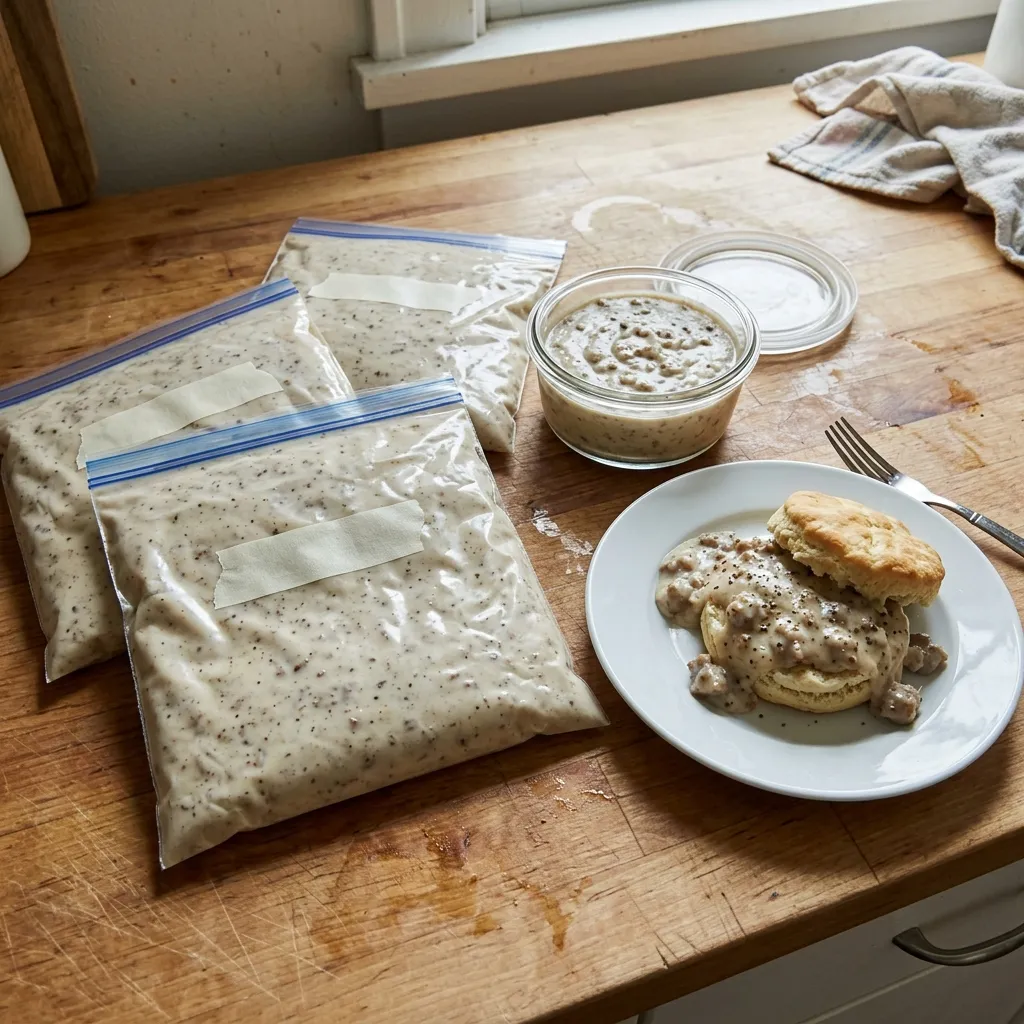
- Fill and seal. Half an inch of room at the top, roughly, because it swells a bit as it freezes. Then squish out as much air as you can before zipping.
- Write on it. Date and amount. Trust me, every frozen bag of beige sauce looks the same in six weeks.
- Freeze it flat. Lay the bags on a sheet pan. Once they’re solid, stand them up like files. They thaw faster and take up way less room.
Oh, and give it a good stir before you bag it. Otherwise one bag gets all the sausage and the next one is basically white sauce. Ask me how I know.
Best Containers and Portion Sizes
Pick containers based on how you’ll use the gravy, not on what’s clean in the cupboard. Smaller portions thaw quicker and you waste less.
The sizes below are rough. Ice cube trays are all over the place, so spoon-measure one of yours.
| Container | Approx. portion | Best for | Thaw (fridge) |
|---|---|---|---|
| Ice cube tray, then bagged | about 2 tbsp per cube | Topping an egg, a quick single biscuit | 1-2 hours, or reheat from frozen |
| Muffin tin cup, then bagged | about 1/2 cup | One generous serving | 3-4 hours |
| Zip bag, 1 cup, frozen flat | 1 cup (240 ml) | Two servings | 6-8 hours |
| Freezer-safe container, 2 cups | 2 cups (480 ml) | Family breakfast | 10-12 hours |
My favorite is the muffin tin trick. Fill the cups, freeze, pop the little gravy pucks out and toss them in a bag. Two pucks, one biscuit, done.
Why Frozen Gravy Separates
Sausage gravy is basically fat, milk and flour holding hands. Freezing breaks that up. Ice crystals push everything apart, and when it thaws you might see little grains or a shiny layer of fat. It looks kind of alarming the first time.
It isn’t spoiled, though. It’s a texture thing, and heat plus a whisk fixes it. In my kitchen, a flour roux (which is how sausage gravy is normally made anyway) comes back together way better than anything thickened with cornstarch. So if freezing is the plan, stick with flour.
How to Thaw Sausage Gravy Safely
The USDA lists three safe ways to thaw (leftovers guide):
- Fridge. Slowest, safest, my go-to. Use it within 3 to 4 days once it’s thawed.
- Cold water. Sealed bag, cold water, then heat it right away.
- Microwave. Fastest. Defrost setting, then cook it immediately.
Just please don’t leave it on the counter to thaw. Freezing doesn’t kill bacteria. It basically puts them to sleep, and they wake right back up as the food warms (USDA FSIS).
Forgot to thaw it? Happens to me constantly. The USDA says you can reheat frozen leftovers straight from the freezer. It just takes a bit longer.
How to Reheat Frozen Sausage Gravy
Stovetop wins for texture. The microwave is fine when you’re rushing out the door.
On the stove (my favorite way):
- Put the thawed gravy, or the frozen pucks, in a small saucepan with 1 to 2 tablespoons of milk for every cup.
- Medium-low heat. Whisk a lot.
- Keep at it while it melts. It’ll look broken for a minute, then somewhere around the 5 to 8 minute mark it suddenly comes together and you’ll go, oh, there it is.
- Bring it up to a bubble. Food safety folks at the USDA say reheated sauces and gravies should hit a rolling boil and leftovers should reach 165°F (74°C). I poke a thermometer in just to be sure.
- Taste. I nearly always add more pepper. Salt only if it’s truly flat, because the sausage brings plenty.
Microwave version: cover the bowl, go in 30 second bursts, stir between each one. Before the final zap, really stir it, like you mean it.
Quick safety note: if you’re making a fresh batch with raw sausage, cook it to 160°F (71°C). That’s the USDA minimum for ground meat and sausage (FoodSafety.gov).
Fixing Grainy, Thin or Greasy Gravy
Nine times out of ten the problem is heat that’s too high or not enough whisking. Here’s my cheat sheet.
| Problem | Likely cause | Fix |
|---|---|---|
| Grainy or separated | Ice crystals broke the emulsion; heated too fast | Whisk over low heat; add 1-2 tbsp warm milk |
| Too thick | Starch tightens in the cold | Add milk 1 tablespoon at a time |
| Too thin | Extra liquid from melting ice crystals | Simmer 3-5 minutes; or whisk 1 tsp flour into 1 tbsp cold milk and stir in |
| Greasy on top | Fat separated | Whisk hard; skim a little off the top if needed |
| Bland | Flavor dulls in the freezer | Add black pepper, a pinch of salt, or a little sage |
| Smells off, or sat out too long | Spoiled | Throw it out |
Honestly, the whisk does most of the work. If you only own one tool for this, make it that.
Can You Freeze Other Kinds of Gravy?
Country and White Gravy
Yep, same deal. Country gravy and white gravy are cousins of sausage gravy (milk, flour, fat), so treat them exactly the same. About 2 to 3 months in the freezer.
Store-Bought and Canned Gravy
The jar or can usually tells you what to do once it’s open, so check there first. No instructions? I just treat it like my own, small portions in bags, and boil it when it’s reheated.
Gravy With Biscuits
Separately! I tried freezing them assembled once, thinking I was clever. Soggy, gluey sadness. Now the biscuits get wrapped in foil and frozen on their own, and they go in the oven while the gravy warms on the stove.
Frozen Store-Bought Gravy Products
If you don’t feel like cooking at all, Eat This did a taste test of four frozen sausage-gravy products back in August 2026. Their winner was the Banquet Sausage and Gravy Deep Dish Pot Pie, which the reviewer said “tasted homemade” (Eat This, Aug. 5, 2026). Fine in a pinch. But a bag of your own gravy costs less and, let’s be real, tastes better.
Freezer-Friendly Sausage Gravy Recipe
This is pretty much my everyday gravy with a couple of small changes for freezing. No cream (it gets oily for me after thawing), whole milk, and good old all-purpose flour. Out of everything I’ve tried, it comes back the smoothest.
Full amounts are in the card. A few things I’d stress:
- Whole milk, please. Low-fat milk separates more once it’s been frozen.
- Really brown the sausage. Don’t rush it. The brown stuck-on bits are basically the whole point.
- Give the flour a minute or two in the fat before adding milk, or the gravy tastes pasty and it’s less stable in the freezer.
- Leave it a little thick. You’ll loosen it up when you reheat.
If you keep breakfast sausage around anyway, my low sodium breakfast sausage patties work great here. Just crumble them into the skillet.
Freezer-Friendly Sausage Gravy
Ingredients
- 1 lb breakfast pork sausage mild or sage, 450 g
- 1/3 cup all-purpose flour 40 g
- 3 cups whole milk 720 ml, plus a splash for reheating
- 1/2 tsp salt or to taste
- 1 tsp black pepper freshly cracked
- 1/4 tsp red pepper flakes optional
Method
- Crumble the sausage into a large skillet over medium heat. Cook 8 to 10 minutes, breaking it up, until well browned and cooked through to 160°F (71°C). Do not drain the fat.
- Sprinkle the flour over the sausage and stir. Cook 1 to 2 minutes so the raw flour taste cooks out.
- Slowly pour in the milk while stirring. Bring to a gentle simmer and cook 5 to 7 minutes, stirring often, until thick enough to coat a spoon. Season with salt, pepper and red pepper flakes. Leave it slightly thicker than you would serve it.
- Spread the gravy in a shallow pan to cool quickly. Refrigerate it within 2 hours of cooking.
- Portion into freezer bags or containers, about 2/3 cup per serving. Press out the air, seal, label with the date and freeze flat. Use within 2 to 3 months for best quality.
- Thaw overnight in the refrigerator. Warm in a saucepan over low heat with a splash of milk, whisking, until smooth and steaming hot to 165°F (74°C).
Notes
Private Notes
Tried this recipe?
Let us know how it was!Ingredient Choices That Help Gravy Freeze Well
Most of the freezer battle is won before you even turn the stove on.
Whole milk. The fat keeps the sauce from breaking. Skim and 2% have more water in them, which means more ice crystals and more separating later on.
Flour, not cornstarch. Every Southern grandma already knew this one. Cornstarch gravy turns oddly gluey after freezing in my kitchen, while a proper flour roux bounces right back.
A sausage you’d happily eat cold. Super fatty sausage can leave a greasy film after thawing. If you see an oily layer before freezing, spoon a bit off.
Hold the fun stuff. I add fresh sage, a handful of cheddar, or a few shakes of hot sauce at reheating time instead. Herbs that went through the freezer come out dark and limp.
How Much Gravy Should You Freeze?
Think about how you eat, not how much is in the pan. A pound of sausage and 3 cups of milk gives me about 4 cups of gravy. That’s roughly six biscuits-and-gravy breakfasts at about 2/3 cup each, which is also a handy number when you’re feeding a crowd.
My loose rule: about 1/3 cup per person for a light breakfast, 2/3 cup for the classic two-biscuit plate, and a full cup if it’s brunch and people are hungry. Hosting eight for a holiday brunch? Freeze about one and a half batches in 2-cup bags.
These are just my planning numbers. Your crew might eat more. Mine definitely does on weekends.
Ways to Use Frozen Sausage Gravy Beyond Biscuits
Once there’s gravy in the freezer, you start finding excuses to use it:
- Over scrambled eggs and toast on a busy weekday morning
- On hash browns or home fries, fried egg on top
- Over chicken fried steak or fried chicken for a Southern-style dinner
- On a baked potato with some chives
- In a breakfast casserole as the creamy layer
- As a dip for toast or breakfast sausage links (don’t knock it)
One puck of gravy, one egg, one slice of toast. Five minutes. That’s the whole reason I bother freezing it.
A Make-Ahead Biscuits and Gravy Plan
The holidays sneak up every year, and Christmas lands on a Friday this time, December 25, 2026. If breakfast is at your place, gravy is one thing you can have done weeks early.
What I do:
- Early December: double batch, frozen in 2-cup bags. Done, forgotten about.
- Christmas Eve-ish: pull a bag into the fridge.
- The morning of: warm it on low with a splash of milk while the biscuits bake.
It keeps a burner free for eggs and potatoes, which on Christmas morning is everything. Spoon it over biscuits, or over my sausage and potato hash if you want something heartier. Add a stack of fluffy buttermilk pancakes and you’ve got a full brunch.
Can You Freeze Sausage Gravy? Your Questions Answered
Can you freeze sausage gravy?
Yes, and it’s one of my favorite freezer shortcuts. Chill it fast, bag it in portions, and eat it within a couple of months. When it comes out, low heat, a little milk, lots of whisking.
How long does sausage gravy last in the freezer?
I aim for 2 to 3 months. Past that it’s still safe if your freezer stays at 0°F (-18°C), it just tastes a bit tired and splits more when you heat it.
Why did my frozen gravy turn grainy?
Totally normal. Freezing pulls the fat, milk and flour apart. Keep the burner low and whisk like crazy, and add a spoonful or two of warm milk if it’s stiff.
Can you refreeze sausage gravy?
The USDA says it’s okay to refreeze food that was frozen once it’s been reheated to 165°F (74°C). I avoid it anyway because the texture gets worse each round, which is exactly why I freeze small bags.
Can you freeze sausage gravy with milk in it?
Sure, that’s what sausage gravy is! Whole milk holds up best. Skim tends to split.
Can you reheat frozen gravy without thawing?
Yep, I do it all the time (the USDA is fine with it too, it’s just slower). Frozen block into a pot, splash of milk, lid on, low flame, whisk as it softens.
Can you freeze biscuits and gravy together?
Technically yes, but you’ll regret it. Soggy biscuits. Freeze them apart.
Last Tip Before You Freeze
Label every single bag with the date. Future you will be very grateful.
Try freezing a half batch this weekend and let me know in the comments how it came back, or which container you liked best. If the recipe helped, a star rating on the card helps other home cooks find it. And pin this one for the next time you’ve got gravy left in the pan.