
My first Dutch baby came out of the oven looking like a sad, flat omelet. My second one nearly hit the oven rack. Same Dutch baby recipe both times. The only thing I’d changed was how long I left the cast iron pan in the oven before the batter went in, and that one detail is most of what this post is about.
Short version, for the impatient (me most mornings): 3 eggs, 3/4 cup flour, 3/4 cup milk, whizzed together, poured into foaming butter in a screaming-hot 10-inch skillet, 425°F for roughly 20 minutes. You get tall, crackly, golden sides and a soft, almost custardy middle. Breakfast for two or three people, start to finish in about half an hour, and nothing in it you’d have to go out and buy.
Below that there’s a pan-size chart, because I got tired of recipes that only work in one skillet, plus the toppings we keep coming back to at our house.
Dutch Baby Recipe
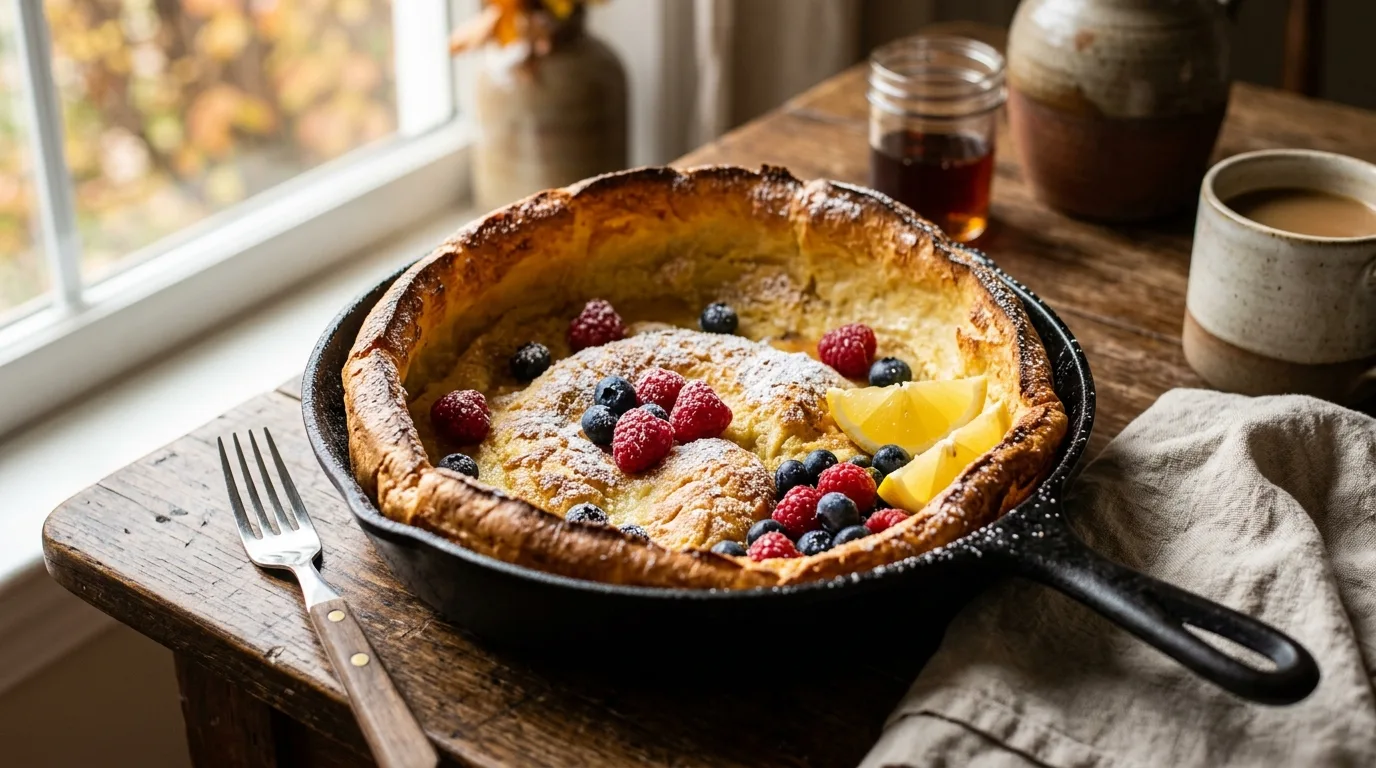
Dutch Baby Recipe (Puffy Oven Pancake)
Ingredients
- 3 large eggs
- 3/4 cup all-purpose flour 95 g, spooned and leveled
- 3/4 cup whole milk
- 1 tablespoon granulated sugar leave out for savory
- 1/2 teaspoon vanilla extract leave out for savory
- 1/4 teaspoon salt
- 3 tablespoons unsalted butter
- 1/2 lemon cut into wedges
- powdered sugar for dusting
- fresh berries optional
Method
- Put a 10-inch cast iron skillet on the middle rack and heat the oven to 425°F (220°C). Once the oven says it is ready, leave the pan in for 10 more minutes.
- While the oven heats, blend the eggs, flour, milk, sugar, vanilla and salt on high for 20 to 30 seconds until smooth and a little frothy. (Or whisk the eggs until frothy, add the milk, then whisk in the flour a little at a time.) Let the batter rest while the pan heats.
- About 2 to 3 minutes before baking, add the butter to the hot skillet and swirl it around. It should melt, foam and just start to brown.
- Give the batter a quick stir and pour it all into the center of the sizzling butter. Close the oven right away.
- Bake for 18 to 22 minutes without opening the door, until the sides have puffed high and the pancake is deep golden brown.
- Bring the pan straight to the table. Squeeze over lemon, dust with powdered sugar, add berries, and cut into wedges. It will sink a little as it cools, which is normal.
Nutrition
Notes
Private Notes
Tried this recipe?
Let us know how it was!What Is a Dutch Baby?
Funny thing, it isn’t Dutch at all. Sunset magazine traces it back to Manca’s Cafe in Seattle, sometime in the early 1900s. Victor Manca was serving little German-style oven pancakes, and one of his daughters started calling them “Dutch babies.” Most people think she was mangling deutsch, which just means German. The name stuck anyway.
My mother-in-law calls it a German pancake. I’ve also heard Bismarck and Dutch puff. All the same pancake, really. Runny eggy batter, sort of like crepe batter, dumped into sizzling butter and left alone till the sides go up the pan.
Made Yorkshire puddings or popovers before? Then honestly you’ve already made one of these. Swap the beef drippings for butter, add a spoon of sugar and a splash of vanilla, and use one big pan instead of a muffin tin.
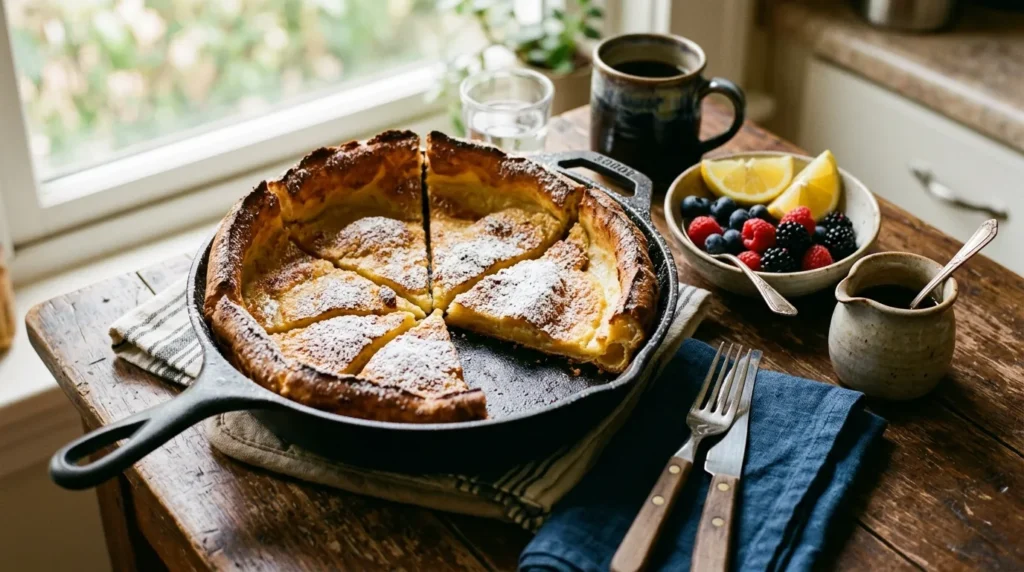
Why It Puffs (and Why Mine Didn’t That First Time)
There’s no baking powder in a Dutch baby, and no yeast. It’s steam, that’s it. Cold batter hits a crazy hot pan, the milk and eggs start steaming like mad, the eggs kind of balloon around it and the oven firms everything up before it sags. Kind of a magic trick, but a fragile one.
So when mine came out flat, the pan just wasn’t hot enough. That’s the usual culprit. Here’s what I check now:
- Pan heat. I put the skillet in while the oven preheats, then give it another 10 minutes after the beep. Ovens lie about being ready. If you don’t hear a loud sizzle when the batter goes in, it’s not ready.
- A short rest for the batter. The Kitchn suggests at least 10 minutes and a quick whisk right before pouring. I just let it sit while the pan heats, so it costs nothing.
- Keep the door shut. I know it’s tempting. Turn on the oven light and peek through the glass for the first 15 minutes.
- Not too much batter. Overfill the pan and the layer is too deep to puff. That’s what the chart further down is for.
- Measure the flour gently. Scooping straight out of the bag packs it down, sometimes by a fifth. I spoon it in and level it off, or weigh it (about 95 g for 3/4 cup).
One thing I stopped worrying about: room-temperature eggs and milk. They blend a touch smoother, sure. But I’ve made plenty of these with everything straight from the fridge on a rushed Sunday and they still rose just fine, as long as the pan was hot.
Which Pan Should You Use?
I use a 10-inch cast iron skillet, and I’d recommend it if you have one. It soaks up heat and holds onto it, so the batter doesn’t cool it down the second it goes in.
That said, I’ve tested others:
- Oven-safe stainless skillet: works great, heats faster than cast iron.
- Glass or ceramic dish: fine, but heat it with the oven plus 10 minutes. Don’t pour batter into cold glass and then put it in, and don’t set the hot dish down on a wet counter. I cracked a Pyrex that way years ago.
- Metal cake pan: okay in a pinch. The sides are low, so use a bit less batter.
- Nonstick: only if the box says it’s safe at 425°F. A lot of them aren’t.
Dutch Baby Size Chart for Different Pans
The ratio I use is simple to remember: equal parts flour and milk by volume, and one egg for every 1/4 cup of each. From there you can size it to whatever you’ve got.
| Pan size | Eggs | Flour | Milk | Butter | Bake at 425°F |
|---|---|---|---|---|---|
| 8-inch | 2 | 1/2 cup | 1/2 cup | 2 tbsp | 15 to 18 min |
| 10-inch | 3 | 3/4 cup | 3/4 cup | 3 tbsp | 18 to 22 min |
| 12-inch | 4 | 1 cup | 1 cup | 4 tbsp | 20 to 25 min |
| 9×13 dish | 6 | 1 1/2 cups | 1 1/2 cups | 5 tbsp | 22 to 28 min |
Sugar stays around a tablespoon per 3 eggs, salt a pinch per egg. I tried doubling the sugar once for a sweeter version and the edges went dark long before the center was done, so I don’t do that anymore.
Blender or Whisk?
I use my blender, mostly because I’m lazy before coffee. Everything goes in, I hit the button for maybe half a minute, and that’s that. No blender? A whisk is fine. Beat the eggs until frothy first, then the milk, then sprinkle in the flour bit by bit so it doesn’t clump. A couple of small lumps won’t hurt anything.
The nice part is the timing lines up on its own. By the time the pan is properly hot, the batter has had its rest.
What We Put on Top
The old-school way is lemon juice and powdered sugar, and I still think it’s the best. The lemon wakes up all that butter and egg. But we rarely stop there.
Sweet ones:
- Berries with a big spoon of whipped cream or Greek yogurt.
- Apples cooked in a little butter and cinnamon. If you’d rather bake the apples right into it, our Bickford’s apple pancake does exactly that.
- Maple syrup, or a drizzle of honey vanilla syrup.
- Whipped honey butter smeared on while it’s still steaming.
- Nutella and banana, which is my kid’s pick every single time.
Savory: drop the sugar and vanilla, add some black pepper and 2 tablespoons of grated Parmesan to the batter. Then top it with whatever’s around:
- Smoked salmon, crème fraîche and dill.
- Bacon, a fried egg and chives.
- Mushrooms sautéed with Gruyère.
- Arugula dressed with lemon and olive oil, plus shaved Parmesan.
Pumpkin Spice Dutch Baby for Fall
This has been our October Saturday breakfast for a few years now. Stir a teaspoon of pumpkin pie spice into the batter, swap in brown sugar for white, and pile sautéed apples or pears on top with some pumpkin spice syrup. Please don’t add pumpkin puree to the batter, though. I tried. It’s heavy and wet and the thing barely rose.
Dutch Baby vs. Pancakes vs. Crepes
People ask me about this a lot, so quickly:
- Regular pancakes have baking powder or soda and a thick batter, cooked on a griddle. Soft and cakey. If that’s the mood, here’s our fluffy pancake recipe.
- Crepes are thin batter, no leavening, cooked in a thin layer. Soft and bendy.
- A Dutch baby starts with crepe-ish batter but bakes in hot butter. Crisp edges, tender middle. Somewhere between a crepe and a popover.
What sold me on it for weekends, more than anything: nobody’s stuck at the stove flipping pancakes while everyone else eats. It goes in the oven, and we all sit down at the same time.
Serving It and Leftovers
Get it to the table fast. It starts sinking a minute or two after it comes out, which is completely normal, but the big puffy moment is half the fun. I cut it into wedges with a pizza cutter. A 10-inch one feeds two hungry adults, or three or four if there’s bacon and fruit on the side.
Leftovers keep in the fridge for about two days if you wrap them well. Warm slices in a 350°F oven or toaster oven for 5 to 7 minutes and the edges crisp up again a little. Skip the microwave, it goes rubbery. It won’t re-puff, obviously, but with fruit and syrup nobody complains.
FAQ
Why is it called a Dutch baby?
The name comes from Manca’s Cafe in Seattle. The owner’s daughter called the little German oven pancakes “Dutch babies,” most likely mixing up deutsch and Dutch.
Can I make a Dutch baby without cast iron?
Yes. Any oven-safe skillet or baking dish works as long as you heat it thoroughly. Cast iron just holds the heat best.
Why did my Dutch baby collapse?
A little deflating as it cools is expected. If it fell while still in the oven, it was probably underbaked or the door got opened too soon. Wait for deep golden brown, not pale gold.
Can I make the batter the night before?
Yes, I do it all the time. Blend, cover, fridge. Give it a quick re-blend in the morning and pour. It rises the same.
Can I make it dairy-free or gluten-free?
For dairy-free, unsweetened oat or almond milk and coconut oil or vegan butter. For gluten-free, a 1-to-1 gluten-free flour blend works, it just won’t climb quite as high.
Is a Dutch baby the same as a Yorkshire pudding?
Close cousins. The batter is nearly identical. Yorkshire pudding is savory, baked in beef drippings and served with roast beef. A Dutch baby uses butter and usually goes sweet.
One last thing I learned the hard way: add the butter only 2 or 3 minutes before the batter. Leave it in a 425°F pan for 10 minutes and it burns. You want it melted, foamy and just turning nutty brown when the batter hits.