
I spent years making pancakes that were fine. Edible, sure, but a little flat and a little chewy, the kind you drown in syrup so nobody looks too closely. What finally gave me a fluffy pancake recipe I trust wasn’t some secret ingredient, it was buttermilk, a mix of baking powder and baking soda, a lumpy batter I was honestly scared to stir, and 15 minutes of leaving it alone on the counter while I made coffee.
My sister calls these the rubber-coaster rescue pancakes, because that’s what hers looked like before I made her try my way. From 2 cups of flour you’ll get somewhere around 14 pancakes, tall and soft, cooked on a griddle at about 350°F, and my kids will put away four each if I don’t stop them.
Apparently half of America had the same idea as me last Saturday (the first one in October 2026). I was poking around Google Trends with my coffee and “homemade pancake recipe” was up 80% in the US that day, “fluffy pancake recipe” up 60%. Ha. So if you landed here with flour already all over the counter, welcome, the card is just below and all my rambling about why it works comes after.
Fluffy Buttermilk Pancake Recipe
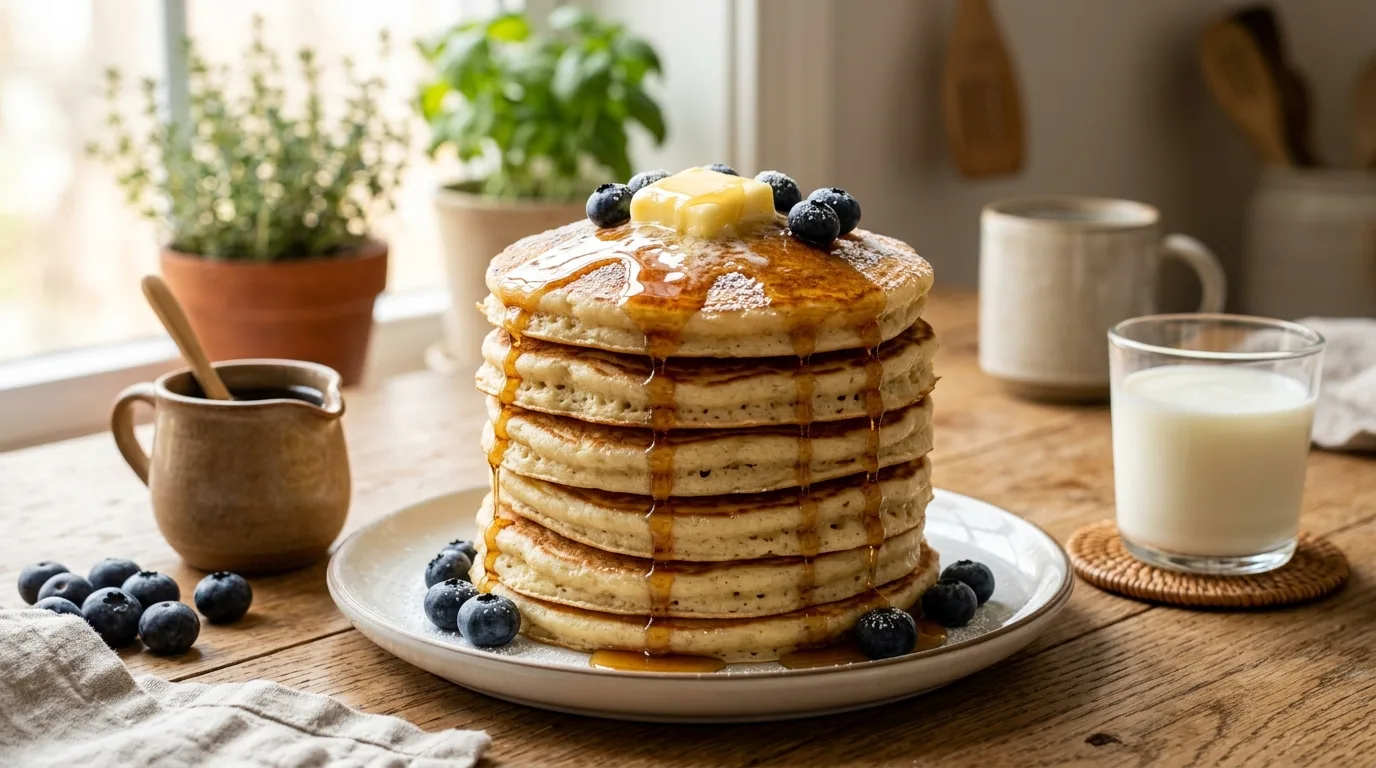
Fluffy Pancake Recipe with Buttermilk
Ingredients
- 2 cups all-purpose flour 250 g, spooned and leveled
- 2 tablespoons granulated sugar
- 2 teaspoons baking powder fresh
- 1/2 teaspoon baking soda
- 1/2 teaspoon salt
- 2 cups buttermilk 480 ml
- 2 large eggs
- 4 tablespoons unsalted butter melted and slightly cooled, plus more for the pan
- 1 teaspoon vanilla extract
Method
- In a large bowl, whisk the flour, sugar, baking powder, baking soda and salt.
- In another bowl, whisk the buttermilk, eggs, melted butter and vanilla.
- Pour the wet ingredients into the dry and stir gently with a spatula just until the flour disappears. The batter should be thick and lumpy. Do not overmix.
- Let the batter rest for 15 minutes. Do not stir it again afterward.
- Heat a griddle to 350°F or a skillet over medium heat. A few drops of water should dance on the surface. Brush lightly with butter.
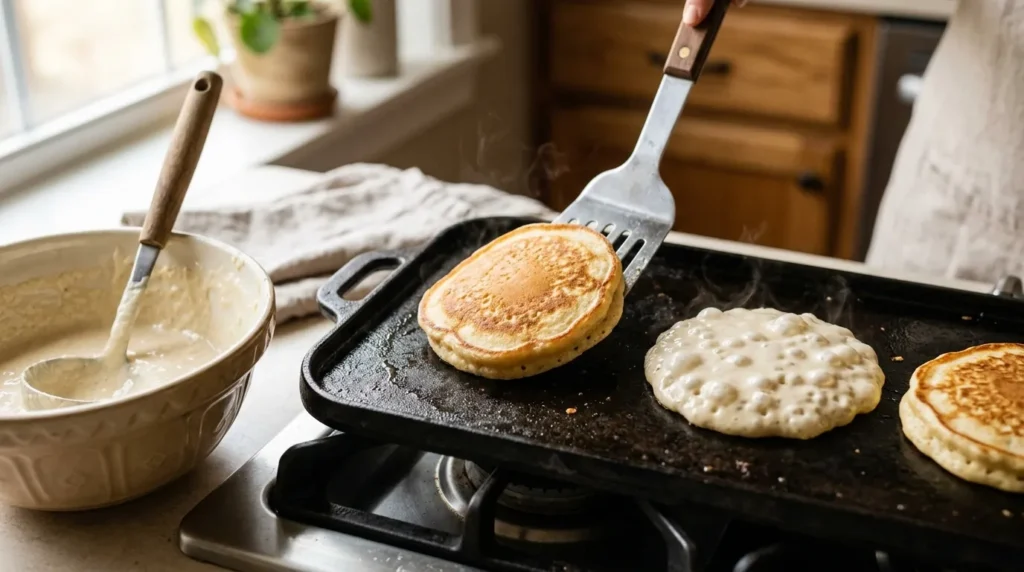
- Pour about 1/4 cup of batter per pancake. Cook for 2 to 3 minutes, until bubbles pop and leave holes that stay open and the edges look dry.
- Flip once and cook the second side for 1 to 2 minutes, until golden brown. Do not press the pancakes. Serve right away or keep warm in a 200°F oven.
Nutrition
Notes
Private Notes
Tried this recipe?
Let us know how it was!What Makes Pancakes Fluffy
My son once asked why restaurant pancakes are “puffier than ours” and I told him it’s bubbles. Tiny ones, stuck in the batter before they can sneak out. Thick batter = more bubbles stay put. That’s kind of the whole thing, and yes he was right, ours were flat back then.
Buttermilk is the big one for me. It’s tangy because it’s acidic, and that acid gets the baking soda fizzing the second they meet. It’s thicker than milk too, so the batter doesn’t run all over the griddle. And that little sour thing in the background? Diner flavor. Took me forever to place it.
Why baking soda AND baking powder? I wondered that too for ages. Soda + buttermilk = instant fizz in the bowl. Baking powder’s “double-acting,” which in normal-person words means it fizzes a bit when wet and then again once it’s hot. So you’re getting one lift in the bowl and another on the griddle. The chemistry folks at Dickinson College wrote a really clear piece on buttermilk and leaveners if you like knowing exactly why things happen.
Melted butter, well, it’s butter, it makes things taste good. Bonus, it gets in the way of the gluten a bit so you don’t end up chewing. And the eggs hold everything in place as it sets. I’ve played with this way more than I’d like to admit, and two eggs for 2 cups of flour is where I ended up, since a third one made them taste eggy and kind of bouncy.
Why Pancakes Come Out Flat
If yours have been dense, it’s almost always one of these, and I’ve been guilty of every single one at some point.
Overmixing
The moment the wet stuff hits the flour, gluten starts forming, and if you keep stirring you’ll end up with tough pancakes that won’t rise much. I put the whisk away and use a spatula, folding until the dry flour has just disappeared and then stopping, even when it looks wrong. It’s supposed to be lumpy. Those lumps cook out on the griddle, I promise.
Skipping the rest
I used to think the 15-minute rest was fussy nonsense, and I was wrong about that. King Arthur Baking calls for the same 15 minutes in their buttermilk pancakes, and once I started doing it I could actually see the batter thicken and go puffy and bubbly on top. Just don’t give it another stir afterward, because you’ll knock all of that right back out.
Pan temperature
Too hot and they scorch on the outside while the middle’s still raw, too cool and they spread out thin and pale before they set. On an electric griddle I go with 350°F. On the stove it’s medium heat and the water test, where you flick a few drops on the pan and watch. If they skitter around and dance, you’re good, and if they just sit there steaming (or vanish instantly), adjust and try again.
Old baking powder
An opened can loses its punch after about six months. Drop half a teaspoon into a little hot water and see what happens, because a big fizz means you’re fine and a few lazy bubbles means it’s time for a new can. This one got me for an entire summer before I figured it out.
Pressing them down
Please don’t squash the pancake with your spatula after you flip it. You’re squeezing out all the air you just worked so hard to keep.
When to Flip
I scoop about 1/4 cup of batter for each one, and then comes the hard part, which is waiting. Watch the top. Bubbles show up, pop, edges go dull and dry-looking. When the popped bubbles leave little holes that stay holes, flip (2 to 3 min, roughly). Don’t chicken out halfway through the flip, that’s how you get folded pancakes, ask me how I know. Other side, a minute or two, peek, golden, done.
The first pancake is always the test pancake anyway. In our house the cook eats it standing up. It tells you if the heat’s off, so tweak and keep going.
No Buttermilk? Try These
Don’t put your shoes on, you’ve got options. Mine’s the lemon one (or white vinegar, whatever’s there): 2 tablespoons in a measuring cup, pour milk in to 2 cups, leave it 5 to 10 minutes. Looks a bit curdly. That’s right. If there’s yogurt in the fridge, King Arthur’s swap of 2/3 cup plain yogurt stirred into 1 1/3 cups milk gives you really tender pancakes. Half a cup of sour cream thinned with 1 1/2 cups milk works too, and kefir you can pour in exactly like buttermilk, no math needed.
Only got plain milk and nothing sour at all? Then skip the baking soda and use 1 tablespoon of baking powder total. They’ll come out a bit shorter and slightly sweeter, but nobody at my table has ever complained.
My Trick for Extra-Tall Pancakes
Birthday breakfast at our place = the tall stack. For that I split the eggs. Yolks in with the wet stuff as usual. Whites, I whip to soft peaks and fold in last, after the rest, gently, like you’re tucking them in. All that extra air makes a real difference in height. I turn the heat down a little for these, to around 325°F, use a slightly bigger scoop, and give them an extra 30 seconds or so on each side since they’re thicker.
Mix-Ins and Flavor Ideas
Here’s a habit that saved me a lot of grey batter: I add mix-ins on top of each pancake right after pouring it on the griddle, never into the bowl. Blueberries are our usual, a small handful each, and frozen ones are totally fine straight from the bag. Mini chocolate chips melt more evenly than the big ones. Thin banana slices with a pinch of cinnamon are lovely, and in the fall I stir 1 1/2 teaspoons of pumpkin pie spice into the dry mix. When I’m feeling fancy it’s half a cup of ricotta and the zest of one lemon folded into the batter.
For toppings, a spoonful of whipped honey butter is my personal favorite, and this time of year we go through a frankly embarrassing amount of homemade pumpkin spice syrup.
Make Your Own Pancake Mix
We make pancakes most weekends, so I keep a jar of the dry ingredients ready to go. Take the flour, sugar, baking powder, baking soda and salt, multiply everything by four, whisk it really well and store it airtight for up to 3 months. On pancake morning you scoop out about 2 1/4 cups and add the buttermilk, eggs, melted butter and vanilla. And if you miss the boxed stuff you grew up with, we’ve got an Aunt Jemima-style pancake mix recipe too.
Keeping Them Warm and Freezing Leftovers
Feeding a crowd? Oven on 200°F, wire rack on a sheet pan inside, and each pancake goes in there as it comes off the heat. Stacked on a plate they steam and go soggy, so the rack really is worth it.
They freeze beautifully, too. I let them cool all the way on the rack, freeze them flat on a tray for an hour, then bag them up with parchment in between, and they’re good for 2 to 3 months. Straight from frozen into the toaster, or about 10 minutes in a 350°F oven. On school mornings this is a lifesaver.
Pancakes vs. Dutch Baby vs. French Toast
Can’t decide what to make on Saturday? Pancakes mean somebody’s stuck at the stove for a while, but everyone gets to choose their own add-ins. A Dutch baby goes into the oven in one pan with zero flipping, which is great when you’d rather sit down with everybody. And French toast uses up stale bread and is on the table in about 15 minutes.
FAQ
What is the secret to fluffy pancakes?
For me it’s thick buttermilk batter, baking soda plus baking powder, barely any mixing, and that 15-minute rest before anything hits the pan.
Why are my pancakes flat?
Nine times out of ten it’s tired baking powder, overmixed batter, or a pan that isn’t hot enough yet. Test your baking powder in hot water and stop stirring the moment the flour disappears.
Should pancake batter be lumpy?
Yep, a little bit. Lumps mean you didn’t overdo it, and they cook away.
Can I make pancake batter the night before?
You can, though they won’t be quite as fluffy, because the baking soda starts working right away and it’s mostly used up by morning. What I do instead is mix the dry and wet separately at night and combine them when I get up.
Butter or oil for the pan?
A thin wipe of neutral oil with a paper towel browns the most evenly. Butter tastes better but burns faster, so I cook in oil and put the butter on top at the table.
How many pancakes does this recipe make?
Around 14, each about 4 inches across with 1/4 cup of batter, which feeds 4 people in my experience.
One last thing: wipe the pan with a paper towel between batches, because those little burnt bits pile up and make the next round spotty and a bit bitter.